

This handout negative dated on April 20, 1943, and taken by Polish firefighter Zbigniew Leszek Grzywaczewski shows Jewish people being evacuated from the Warsaw Ghetto. Z. L. Grzywaczewski/Maciej Grzywaczewski/POLIN Museum via AP hide caption
toggle caption
Z. L. Grzywaczewski/Maciej Grzywaczewski/POLIN Museum via AP

This handout negative dated on April 20, 1943, and taken by Polish firefighter Zbigniew Leszek Grzywaczewski shows Jewish people being evacuated from the Warsaw Ghetto.
Z. L. Grzywaczewski/Maciej Grzywaczewski/POLIN Museum via AP
WARSAW, Poland — Warsaw’s Jewish history museum on Wednesday presented a group of photographs taken in secret during the Warsaw Ghetto Uprising of 1943, some of which have never been seen before, that were recently discovered in a family collection.
The POLIN Museum of the History of Polish Jews described the discovery of negatives with some 20 never-seen images as important discovery.
The photos were taken inside the Warsaw Ghetto by a Polish firefighter, Zbigniew Leszek Grzywaczewski, as the Nazi Germans were brutally crushing the uprising of 1943. As the Germans burned down the ghetto, they called in Polish firefighters to keep the flames from engulfing nearby buildings outside the ghetto.
The museum’s historians said that the value of Grzywaczewski’s pictures lies in their being the only known images from the ghetto uprising that were not taken by the German forces, and which therefore were not shot with the intention of serving Nazi propaganda.
Grzywaczewski, then a 23-year-old whose family members were risking their lives to save Jews, took his camera into the ghetto and secretly photographed Jews being led to Umschlagplatz, the holding area where the occupying German forces held them before deportation to the Treblinka death camp. The images also show burning buildings.

This undated handout negative taken byZbigniew Leszek Grzywaczewski shows the Warsaw Ghetto during the uprising of 1943. Zbigniew Leszek Grzywaczewski/Maciej Grzywaczewski/POLIN Museum via AP hide caption
toggle caption
Zbigniew Leszek Grzywaczewski/Maciej Grzywaczewski/POLIN Museum via AP

This undated handout negative taken byZbigniew Leszek Grzywaczewski shows the Warsaw Ghetto during the uprising of 1943.
Zbigniew Leszek Grzywaczewski/Maciej Grzywaczewski/POLIN Museum via AP
Grzywaczwski’s son, Maciej Grzywaczewski, recently found negatives with the images in the collection of his father, who died in 1993. He said he became very emotional when he found them.
Some of his father’s other images, including photos capturing the Jews being deported, are held by the U.S. Holocaust Memorial Museum in Washington.
POLIN says the discovery adds more pictures to the deportation sequence. Furthermore, the ones in Washington are prints that have been cropped, with the newly discovered negatives offering more details.
Some of the photos are blurred or not framed well, indicating that Grzywaczewski, who was an avid photographer, was taking them surreptitiously.

This handout negative dated on April 20, 1943, and taken by Polish firefighter Zbigniew Leszek Grzywaczewski shows houses being set on fire in the Warsaw Ghetto. Zbigniew Leszek Grzywaczewski/Maciej Grzywaczewski/POLIN Museum via AP hide caption
toggle caption
Zbigniew Leszek Grzywaczewski/Maciej Grzywaczewski/POLIN Museum via AP
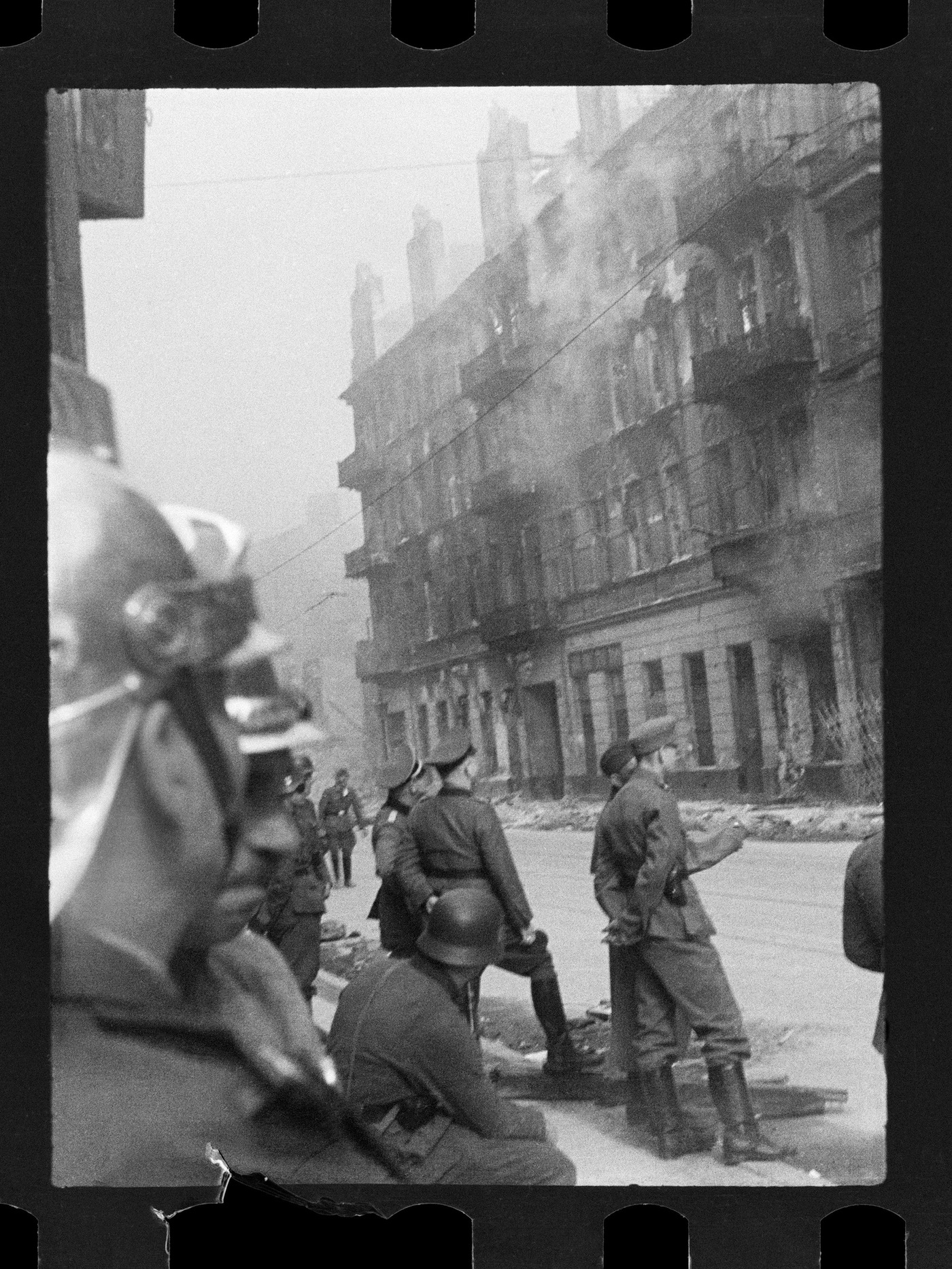
This handout negative dated on April 20, 1943, and taken by Polish firefighter Zbigniew Leszek Grzywaczewski shows houses being set on fire in the Warsaw Ghetto.
Zbigniew Leszek Grzywaczewski/Maciej Grzywaczewski/POLIN Museum via AP
The newly discovered images will be included in an exhibition at the POLIN museum called “Around Us a Sea of Fire,” opening on April 18, the eve of the 80th anniversary of the Warsaw Ghetto Uprising’s outbreak.
It began on April 19, 1943, after German troops and police entered the ghetto to deport its surviving inhabitants. Some 750 young Jewish fighters armed with just pistols and other light arms attacked a German force more than three times larger. In their last testaments they said they knew they were doomed but wanted to die at a time and place of their own choosing.
In the end, the fighters held out nearly a month, longer than some German-invaded countries did.
It was largest uprising by Jews during World War II and the first significant urban revolt against the German occupation in Europe. By May 16, 1943, the Germans had crushed the uprising and deported surviving ghetto residents to concentration and death camps.
